Concrete is the undisputed backbone of modern construction. However, despite its exceptional compressive strength, traditional concrete has inherent weaknesses: poor tensile strength and a high susceptibility to cracking. To overcome these limitations and ensure long-term structural stability, reinforcement systems are essential.
Today, engineers and contractors primarily choose between two dominant reinforcement methods: Fiber Reinforced Concrete (FRC) and Steel Rebar. Both offer distinct advantages and weaknesses. In this comprehensive guide, we will break down their differences in functionality, application scenarios, and cost-efficiency to help you make the right choice for your next project.
What is Fiber Reinforced Concrete (FRC)?
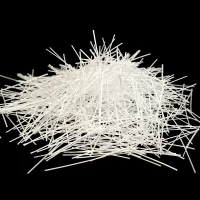
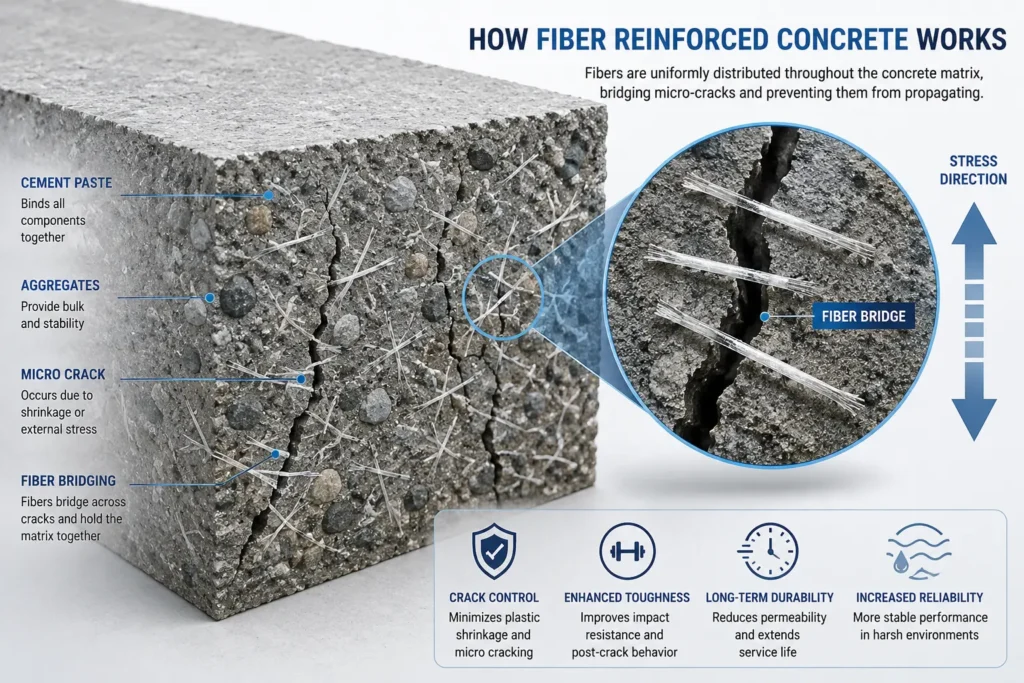
Fiber-reinforced concrete is a highly advanced composite material created by mixing uniform, evenly distributed fibers directly into the cement matrix.
Concrete naturally experiences shrinkage and external stress, which leads to micro-cracking. High-quality fibers act as an internal support system, bridging these microscopic flaws before they can expand. By controlling crack initiation and propagation at the micro-level, fibers significantly enhance the concrete’s post-crack toughness and overall durability.
Common Types of Concrete Reinforcement Fibers
Depending on the engineering requirements, different fiber materials are utilized:
- Synthetic Fibers (e.g., Polypropylene/PP Fibers): The most popular choice for controlling early-stage plastic shrinkage cracks.
- Steel Fibers: Engineered to provide exceptional toughness, impact resistance, and energy absorption in heavy-duty applications.
- Glass Fibers: Offering high tensile strength, alkali-resistant fiberglass is ideal for precast architectural components and decorative cladding.
- Natural Fibers: Eco-friendly alternatives like cellulose fibers that help mitigate shrinkage.
What is Steel Rebar?
Short for “reinforcing bar,” rebar involves casting connected metal bars inside the concrete before it cures. Since the mid-19th century, this method has been the global standard for structural reinforcement.
While concrete handles compressive forces (pushing together), the steel rebar framework handles tensile forces (pulling apart), shear, and bending stresses. Without rebar, concrete structural elements like beams and columns would be dangerously brittle under heavy, dynamic loads.
Common Types of Rebar
- Material Based: Carbon steel (standard), Stainless steel, and Epoxy-coated rebars (for corrosion resistance).
- Specialized: Fiber Reinforced Polymer (FRP) and Fiberglass rebar.
(Note: For the purpose of this comparison, “rebar” refers to traditional steel reinforcing bars.)
Head-to-Head Comparison: Fiber vs. Rebar
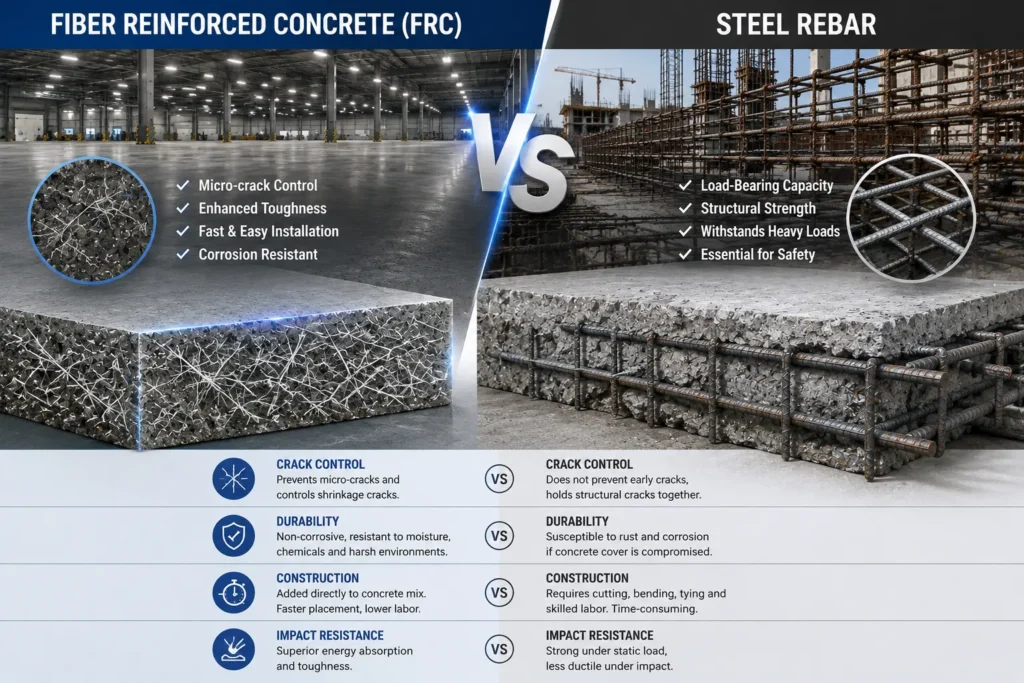
Fiber and rebar perform completely different roles within a concrete slab. Understanding their distinctions is crucial for material specification.
1. Crack Control Behavior
- Fibers (Micro-Level): Fibers actively prevent the formation of plastic and drying shrinkage cracks during the curing process. They also absorb thermal movements, stopping tiny fissures from becoming visible surface defects.
- Rebar (Macro-Level): Rebar does not prevent early-stage concrete shrinkage. Its job begins after the concrete has hardened and cracked, holding the structural pieces together and managing the distribution of those larger cracks.
2. Strength and Structural Capacity
- Fibers (Toughness): Fibers dramatically improve material resilience, impact resistance, and energy absorption. They prevent sudden brittle failure but do not replace primary structural load-bearing capacity.
- Rebar (Load-Bearing): Rebar is non-negotiable for structural strength. It defines the concrete’s ability to resist heavy bending, shear, and continuous static loads.
3. Durability and Environmental Resistance
- Fibers: Synthetic and glass fibers are completely inert and non-corrosive. They provide incredibly stable performance in humid, coastal, or chemically aggressive environments.
- Rebar: Steel is highly susceptible to rust and corrosion if moisture and chlorides penetrate the concrete cover. Once rebar rusts, it expands, causing the concrete to spall and deteriorate.
4. Construction Speed and Cost Efficiency
- Fibers: Highly efficient. Fibers are simply added to the concrete mix at the batch plant or onsite. This eliminates the need for lifting, placing, and tying heavy steel, significantly reducing labor costs and accelerating project timelines.
- Rebar: Labor-intensive. Steel must be transported, cut, bent, hoisted, and painstakingly tied by skilled ironworkers before pouring can even begin. While raw steel might seem cheaper, the total installed cost (labor + time) is often much higher.
Quick Reference Comparison Table
| Feature | Fiber Reinforced Concrete (FRC) | Steel Rebar |
|---|---|---|
| Primary Function | Micro-crack control & material toughness | Macro structural capacity & load-bearing |
| Crack Prevention | Excellent (controls plastic/thermal shrinkage) | Limited (only holds structural cracks together) |
| Durability | High (non-corrosive, chemical resistant) | Vulnerable to rust if exposed via cracks |
| Impact Resistance | Superior energy absorption | Strong under static load, rigid |
| Installation | Fast (mixed directly into the matrix) | Slow (requires cutting, bending, and tying) |
| Labor Cost | Low | High (requires skilled ironworkers) |
How to Choose the Right Reinforcement Strategy
The choice between fiber and rebar—or a combination of both—depends entirely on your project’s demands.
When to Rely on Fiber Reinforced Concrete
If your primary goals are surface integrity, fast construction, and shrinkage control without heavy structural loads, FRC is the superior choice.
- Ideal for: Industrial floors, driveways, pavements, thin concrete overlays, and ground-supported slabs.
When Steel Rebar is Mandatory
If the concrete element must carry significant weight, span across open spaces, or withstand high bending forces, rebar is an absolute necessity for safety.
- Ideal for: Suspended beams, structural columns, foundational footings, and retaining walls.
The Hybrid Approach: Combining Both Systems
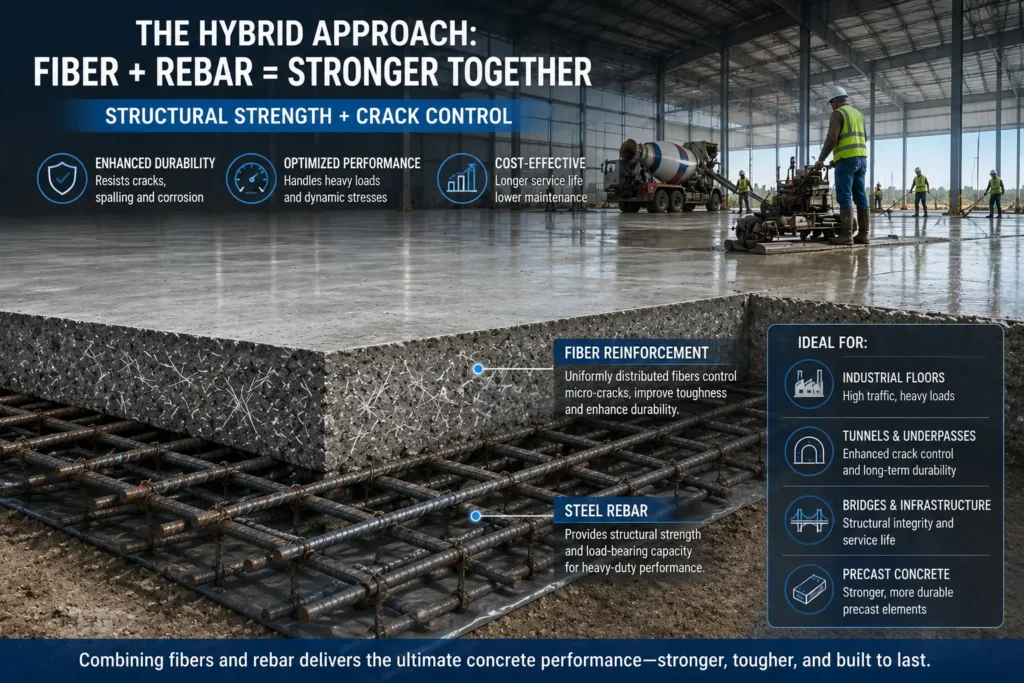
For world-class durability, modern engineering often combines both. Using rebar to handle the primary structural loads and adding concrete reinforcement fibers to eliminate surface micro-cracking results in a slab that is structurally sound and visually flawless. This hybrid method is the gold standard for heavy-duty industrial flooring, tunnels, and precast elements.
Elevate Your Concrete Performance with Fiberego
The effectiveness of Fiber Reinforced Concrete relies entirely on the quality and uniform dispersion of the fibers used.
Katika Fiberego, we specialize in supplying premium concrete reinforcement fiber products engineered for maximum performance. Whether you need synthetic fibers for superior shrinkage control or heavy-duty solutions for impact resistance, Fiberego provides raw materials that integrate seamlessly into your mix design—ensuring optimal workability, zero pumping blockages, and unmatched long-term durability.
Optimize your next pour with Fiberego’s reinforcement solutions.
Frequently Asked Questions (FAQ)
1.Why do cracks still appear in fiber-reinforced concrete?
Fibers are designed to control the width and spread of cracks, not defy the laws of physics. They prevent micro-cracks from growing into damaging macro-cracks, preserving the concrete’s structural integrity.
2.Does adding fiber affect concrete workability?
It can, if inferior fibers are used or if the dosage is incorrect. High-quality fibers from trusted suppliers like Fiberego are engineered to disperse evenly without clumping, minimizing impact on flow and preventing pump blockages.
3.Are fiber and rebar interchangeable?
No. They serve completely different purposes. Think of fibers as material-level protection (toughness and crack control) and rebar as the structural skeleton (load-bearing).
4.Does fiber improve freeze-thaw resistance?
Yes. By drastically reducing the network of micro-cracks, fibers prevent water from penetrating deep into the concrete matrix, thereby minimizing internal pressure and damage during freeze-thaw cycles.